A Beautiful Life Begins With a Vision
A beautiful life begins with hope for what still lies ahead. Discover how creating a vision after 50 can bring renewed direction, purpose, and possibility to your next chapter.
LIFEFEATUREDBEAUTY
Tammy Renée
6 min read


We Are Not Beginning With a Blank Page
By the time we reach midlife, we’re not standing in front of a blank page.
We have lived a full life, filled with both joys and sorrows, and we still have obligations and people we love who depend on us.
That’s why many of these simplistic messages about “midlife reinvention” can feel so hollow.
Most of us can’t leave everything behind and begin again — nor should we necessarily want to. What we’ve built over the course of our lives means something to us.
So, a new vision isn’t about leaving things that you value behind; it’s about seeing what can still be created within them.
The author, Madeleine L’Engle, once compared life to a sonnet.
"Life, with its rules, its obligations, and its freedoms, is like a sonnet: You're given the form, but you have to write the sonnet yourself."
In other words, a sonnet has rules and a predetermined form, but within that form, the writer must still create the poem.
I have always found that idea hopeful.
Sometimes, we don’t get to choose every condition of our lives. And we can’t revise every line that’s already been written. But we can still participate in creating what comes next.
We are given the form, but we still write the sonnet.
There is freedom within those boundaries.
A woman may not be able to (or want to) change her entire life, but she might be able to change how she spends one morning each week quietly working toward something that matters to her.
I did that when, in my 50s, I decided to dust off a dream of mine: completing my master's degree. I already had a demanding full-time job, so I knew any vision I had was going to have to fit within that.
So, I set my alarm every weekday morning and worked on my grad school assignments from 4 to 6 before going to work. And slowly, one course completed at a time, I will graduate in December of this year — two months before my 60th birthday.
That vision didn’t begin with one dramatic decision — or leaving my responsibilities behind.
It began with quietly carving out the time I could for a long-held dream. It began with one small act of authorship.
“I dwell in possibility.” —Emily Dickinson
A beautiful life is not just about the aesthetics.
It also requires a sense of direction — a vision.
And a vision, at its heart, is about hope.
It’s the belief that, no matter your age, your life is still unfolding and that something meaningful can still be created or experienced.
It’s the belief that you still have places to go, things to learn and do, relationships to enjoy, and goals to pursue.
You may be in midlife and want to write a book, return to school, begin a business, travel somewhere you’ve always wanted to go, create a more peaceful home, or learn to paint.
Or some of you may not know what you want at this stage of your life. You only know that you want to feel more excited and inspired again. You want something to look forward to. You want to live with intention and feel more purposeful, rather than living on autopilot.
But here’s something to keep in mind:
You don’t need to see the entire road ahead of you before you begin.
You only need enough light to see that another step is possible.
The Difference Between Living and Responding
Most of us have been the responders for much of our adult lives. We’ve responded to the needs of our children, spouses, parents, employers, homes, and communities. We’ve adjusted to circumstances, solved problems, attended to what was urgent, and carried out responsibilities that truly mattered to us.
But after years of responding to what life has asked of us, we can sometimes lose touch with what we’re asking of life.
Without some sense of what we’re moving toward in the second half of life, it’s easy to continue spending our years responding to life — without also intentionally shaping it.
Thus, having a vision means having a direction in which to face.


Our Most Meaningful Work May Still Be Ahead
Our culture speaks of possibility as though it only belongs to the young.
We celebrate early achievement, overnight success, and the person who knew exactly what she wanted to do from childhood. This can create the impression that our important beginnings should already be behind us by the time we reach 50.
Yet life — and history — repeatedly proves otherwise.
Julia Child, the famous chef and cookbook author, didn’t become a familiar television presence until she was in her fifties.
Laura Ingalls Wilder, the beloved author of the Little House books, didn’t start writing them until she was in her sixties.
Martha Stewart launched her magazine, Martha Stewart Living, near the age of 50.
Their stories are inspiring, not because we should all desire to become famous, but because they remind us that creativity, contribution, and new beginnings can happen at any age.
And for every well-known woman who began something later in life, there are countless ordinary women doing equally courageous things outside of the public eye.
The woman who returns to school after raising her family.
The woman who begins painting after a lifetime of thinking she wasn’t all that creative.
The woman who finds purpose in starting her own online business in midlife.
The woman who moves to a new place, learns a language, starts gardening, volunteers for a cause she deeply believes in, or finally writes the stories she’s been carrying inside her for years — even if only her grown children and grandchildren read them.
All of these are evidence of what is still possible.
A New Vision Is Not Always an Old Dream
“True originality consists not in a new manner but in a new vision.”
—Edith Wharton
There are times when creating a new vision means returning to an old dream — like writing, art, music, travel, education, entrepreneurship, or another desire we once set aside.
However, a renewed vision doesn’t always mean going back to who we once were. The dreams we had in our 20s may be of little interest to us now.
So, when creating a vision for your next chapter, know that it’s okay to release old dreams and embrace new ones that may be more fitting to the values and interests of the woman you are today.
Vision Gives Shape to Our Everyday Life
When we have a sense of what we are moving toward, our everyday choices begin to take on greater meaning.
We become more intentional about what deserves our time. We recognize which commitments support the life we want going forward. And we begin to notice where our surroundings, routines, and relationships are either helping us grow — or slowly draining our energy.
This is the difference between simply a full life and a purposeful one.
Reflect on the following questions:
What have I been postponing until a more convenient season?
What ideas give me energy or a sense of possibility?
What would I like to learn, create, experience, or contribute?
The Courage to Hope for What Comes Next
Having a vision takes courage, belief, and patience.
It asks more of us.
It asks us to believe that the future may still hold things worth preparing for and doing.
It asks us to look beyond the life we have been living and to imagine the life we might begin creating now.


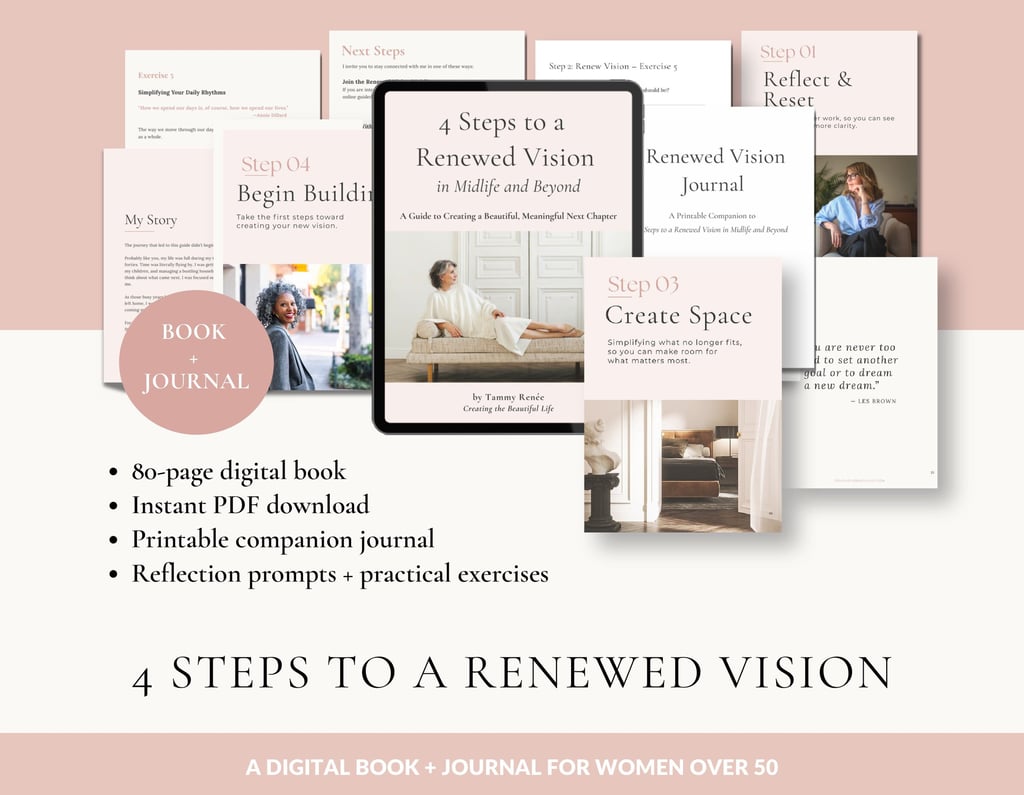
Creating a Renewed Vision
If you’re ready to begin creating a renewed vision, I can help.
4 Steps to a Renewed Vision—in Midlife and Beyond offers a thoughtful process for moving from uncertainty toward greater clarity, hope, and direction.